For the past 7 or 8 years MBOTMA has sponsored two contests at the MN State Fair: The Minnesota Duet Championship and the Minnesota Flatpicking Guitar Contest. Lynn and I had been participants in both contests until last year, when I had hip replacement surgery at the end of July. We were going to give it a rest for another year: we had a really busy summer - 4 out-of-town weddings plus Lynn was working on a choral anthem commission. However, last week we got an email saying that MBOTMA needed more contestants for the Guitar Contest and that a few openings remained for Duets. Last Friday, after talking it over with Lynn, I registered for both contests.
Last winter and spring I had been thinking about tunes that might work, just in case we entered this year. By their nature, Flatpicking contests are geared toward a bluegrass style which takes a basic fiddle tune and adds variations. I was never too good at coming up with variations, although every once in a while something would come together. And, over the past number of years I have become more and more interested in 'old-time' music, both songs and tunes. Last spring I started going to an old time jam (sporadically), bringing my mandolin and leaving the guitar at home. Thus, I came to a decision to pick some 'old-time' tunes and to play them pretty straight. There are a couple of Missouri fiddle tunes that I've played on guitar for quite a while, at least one of them I learned at a slow tempo long before I ever played in the flatpicking contest. These are from The Old-Time Fiddle Repertory, a book of Missouri fiddle tunes compiled by R. (Bob) Christensen.
Smith's Reel: a two part reel in D, I have looked at other tunes called Smith's Reel, and although there are some similarities, I haven't really seen this any where else.
Bittercreek: a 4-part tune (AABBCCDD) in G. Adam Granger has a 3-part version in his book which is similar. Adam, who's one of the judges, calls it a Texas Fiddle tune.
Although I am playing these straight, I did work out the guitar arrangements and fingering from the written music. I am playing each of them twice.
If, by some chance or miracle I make the top five (it did happen once), I have 2 other tunes:
Bonaparte Crossing the Rhine: this is a version I worked out and is on the Bob&Lynn CD Blue-eyed Boatman. This does use some variations: I used this for the contest 2 or 3 years ago. Each section is rather long, so I am playing it A-B three times, with a repeat of the A section as a Coda. I play in G position with the Capo on the 2nd fret. I need to remove the capo before playing the 2nd tune.
Round the Horn: a tune in G from the Portland Book, a book of contra-dance tunes. I learned it first on mandolin, then started playing around with it as a guitar contest piece 2 years ago. I have worked out a variation for this and play it three times through (the variation on the 2nd time through, reasonably straight 1st and 3rd).
For the first round of the Duet contest Lynn and I are doing two songs that have been in our repertoire for some time. If we make to the finals (which we have done a few times), we will do one that is relatively new. For all the songs we use two guitars for accompaniment.
First round songs:
The Raging Sea: I first learned this from a New Lost City Ramblers recording, but also listened to the 'source' by Ernest Stoneman. We do this at a fairly brisk tempo and even though it's a song about 'death at sea', there is some humor in it. (at least for me). We are playing it in E-flat (with Capos).
Broken Hearted Lover: a Carter family song that we learned from a Jody Stecher and Kate Brislin a number of years back. We played a truncated version of this for the first duet contest, when the time limit was listed as doing 2 songs in 5 minutes. I had to cut and eliminate some guitar breaks so it didn't go too well. Now that a more realistic limit of 4 minutes per song is the rule, we will do the version that we perform. We recorded this when we were making our CD, but it did not make the final cut. This is in B flat and our capos remain in the same position (Bob @ 3rd fret, Lynn @ 1st fret).
For the final round, if we make it:
Over the Mountain: we have versions by Uncle Dave Macon and Kenny Jackson. Lynn did some searching on line and found the words from the original sheet music from the 1880's. We melded all these versions into our own, but kept the yodeling that Uncle Dave added. This in E-flat. Lynn's capo is on the 1st fret, but I move mine all the way up to the 8th fret and play in G position.
Tuesday, August 31, 2010

Friday, August 27, 2010
Coin Collector?
A round of Facebook postings a month or so ago had me looking at my old coin collection and has rekindled my interest: something to do during retirement when I'm not playing guitar? I collected as a teen-ager (and may even had gotten a coin-collecting merit badge when I was a Boy Scout). I 'inherited' a number of coins from my grandfather, but except for a few Indian head pennies, I have lost most of them. Over the years I have occasionally added to the collection and I even bought a couple of folders when the series of 'state' quarters came out.
I have been focusing on the Indian Head Collection which has over 30 coins in it. I had taken a few pictures with a USB Microscope of some coins and one or two of the nicer Indian Heads, so I started a project to get pictures of all of them. And of course, I have taken advantage of a few things that weren't around when I was a teenager. In Google Docs, I started a spreadsheet to make an inventory of the Indian Heads with columns for such things as year, mint, condition, wholesale & retail value etc. And I store the pictures on photoshop.com.
Here's a couple that I've taken:
This 1859 is one from my Grandfather and is in great condition (I grade it VF35 which is one notch below "extremely fine" (XF40). 'Wholesale' price is about $40, this is a fairly common date, but the 'quality' gives it some value.

This one from 1869 is a much rarer date, but is in pretty bad condition - maybe AG-2, since you have a clear view of the date.

I also started tracking coins on EBay and found that thousands of them are up for bid: usually around 12,000 for Indian Head cents alone. I've bid on a few and won some. I bought the 2011 "blue" book, which gives wholesale prices and I just ordered the 'red' book, which is 'retail'.
Here's a 1908 I got from EBay which I consider XF40, this is a fairly common date, so even in this condition it is only worth about $5.00 (which is about what I paid for it).

A coin's value is determined by it's rarity and condition (and of course 'the market'). One thing 'new' is that the grading has become much more precise since my initial days of coin collecting - here's a link to current grading system used by most folk (and the 'blue' book): PCGS Coin Grading Standards. This site will actually grade your coin(s) and 'freeze' them in plastic, something like this:

This same site has photographs of coins for grading, and I have started to use that. I found that I was probably 'undergrading' many coins: something I would grade G4 was really VG8 or higher. The 'photograde' site for Indian Head Cents is here.
The photo album for my Indian Head Cents is here.
I have also bought some folders for some other coin sets, including 2 books for Lincoln Memorial Cents. I moved the few I had from another Lincoln set book, then started going through our 'penny jar'. Perhaps because we are in Minnesota, I have filled in all the 'D' slots (Denver mint). I am missing quite a view 'plain' (Philadelphia) and 'S' (San Francisco) pennies. Note that only a few years have the S mint mark. Lincoln Memorials were minted from 1959 through 2008. (I remember when they first came out). In 2009, there was a special series for the bicentennial of Lincoln's birth, then starting in 2010, a new 'reverse' is used. More information from Wikipedia: http://en.wikipedia.org/wiki/Penny_(United_States_coin)#Lincoln_penny. Most Lincoln memorial pennies are worth 1 cent, unless they are in 'mint state' (MS-65) or a proof (PF-70). I won't be searching EBay for missing dates, but will check the pennies I get in change.
I have a fair number of Lincoln 'Wheat' cents and will probably start categorizing and photographing those as my next 'project'.
.
I have been focusing on the Indian Head Collection which has over 30 coins in it. I had taken a few pictures with a USB Microscope of some coins and one or two of the nicer Indian Heads, so I started a project to get pictures of all of them. And of course, I have taken advantage of a few things that weren't around when I was a teenager. In Google Docs, I started a spreadsheet to make an inventory of the Indian Heads with columns for such things as year, mint, condition, wholesale & retail value etc. And I store the pictures on photoshop.com.
Here's a couple that I've taken:
This 1859 is one from my Grandfather and is in great condition (I grade it VF35 which is one notch below "extremely fine" (XF40). 'Wholesale' price is about $40, this is a fairly common date, but the 'quality' gives it some value.

This one from 1869 is a much rarer date, but is in pretty bad condition - maybe AG-2, since you have a clear view of the date.

I also started tracking coins on EBay and found that thousands of them are up for bid: usually around 12,000 for Indian Head cents alone. I've bid on a few and won some. I bought the 2011 "blue" book, which gives wholesale prices and I just ordered the 'red' book, which is 'retail'.
Here's a 1908 I got from EBay which I consider XF40, this is a fairly common date, so even in this condition it is only worth about $5.00 (which is about what I paid for it).

A coin's value is determined by it's rarity and condition (and of course 'the market'). One thing 'new' is that the grading has become much more precise since my initial days of coin collecting - here's a link to current grading system used by most folk (and the 'blue' book): PCGS Coin Grading Standards. This site will actually grade your coin(s) and 'freeze' them in plastic, something like this:
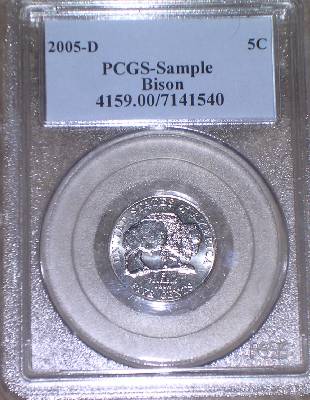
This same site has photographs of coins for grading, and I have started to use that. I found that I was probably 'undergrading' many coins: something I would grade G4 was really VG8 or higher. The 'photograde' site for Indian Head Cents is here.
The photo album for my Indian Head Cents is here.
I have also bought some folders for some other coin sets, including 2 books for Lincoln Memorial Cents. I moved the few I had from another Lincoln set book, then started going through our 'penny jar'. Perhaps because we are in Minnesota, I have filled in all the 'D' slots (Denver mint). I am missing quite a view 'plain' (Philadelphia) and 'S' (San Francisco) pennies. Note that only a few years have the S mint mark. Lincoln Memorials were minted from 1959 through 2008. (I remember when they first came out). In 2009, there was a special series for the bicentennial of Lincoln's birth, then starting in 2010, a new 'reverse' is used. More information from Wikipedia: http://en.wikipedia.org/wiki/Penny_(United_States_coin)#Lincoln_penny. Most Lincoln memorial pennies are worth 1 cent, unless they are in 'mint state' (MS-65) or a proof (PF-70). I won't be searching EBay for missing dates, but will check the pennies I get in change.
I have a fair number of Lincoln 'Wheat' cents and will probably start categorizing and photographing those as my next 'project'.
.
Subscribe to:
Posts (Atom)