Friday, December 3, 2010

Tuesday, August 31, 2010
Songs and Tunes for the State Fair Duet and Flatpicking Contests
For the past 7 or 8 years MBOTMA has sponsored two contests at the MN State Fair: The Minnesota Duet Championship and the Minnesota Flatpicking Guitar Contest. Lynn and I had been participants in both contests until last year, when I had hip replacement surgery at the end of July. We were going to give it a rest for another year: we had a really busy summer - 4 out-of-town weddings plus Lynn was working on a choral anthem commission. However, last week we got an email saying that MBOTMA needed more contestants for the Guitar Contest and that a few openings remained for Duets. Last Friday, after talking it over with Lynn, I registered for both contests.
Last winter and spring I had been thinking about tunes that might work, just in case we entered this year. By their nature, Flatpicking contests are geared toward a bluegrass style which takes a basic fiddle tune and adds variations. I was never too good at coming up with variations, although every once in a while something would come together. And, over the past number of years I have become more and more interested in 'old-time' music, both songs and tunes. Last spring I started going to an old time jam (sporadically), bringing my mandolin and leaving the guitar at home. Thus, I came to a decision to pick some 'old-time' tunes and to play them pretty straight. There are a couple of Missouri fiddle tunes that I've played on guitar for quite a while, at least one of them I learned at a slow tempo long before I ever played in the flatpicking contest. These are from The Old-Time Fiddle Repertory, a book of Missouri fiddle tunes compiled by R. (Bob) Christensen.
Smith's Reel: a two part reel in D, I have looked at other tunes called Smith's Reel, and although there are some similarities, I haven't really seen this any where else.
Bittercreek: a 4-part tune (AABBCCDD) in G. Adam Granger has a 3-part version in his book which is similar. Adam, who's one of the judges, calls it a Texas Fiddle tune.
Although I am playing these straight, I did work out the guitar arrangements and fingering from the written music. I am playing each of them twice.
If, by some chance or miracle I make the top five (it did happen once), I have 2 other tunes:
Bonaparte Crossing the Rhine: this is a version I worked out and is on the Bob&Lynn CD Blue-eyed Boatman. This does use some variations: I used this for the contest 2 or 3 years ago. Each section is rather long, so I am playing it A-B three times, with a repeat of the A section as a Coda. I play in G position with the Capo on the 2nd fret. I need to remove the capo before playing the 2nd tune.
Round the Horn: a tune in G from the Portland Book, a book of contra-dance tunes. I learned it first on mandolin, then started playing around with it as a guitar contest piece 2 years ago. I have worked out a variation for this and play it three times through (the variation on the 2nd time through, reasonably straight 1st and 3rd).
For the first round of the Duet contest Lynn and I are doing two songs that have been in our repertoire for some time. If we make to the finals (which we have done a few times), we will do one that is relatively new. For all the songs we use two guitars for accompaniment.
First round songs:
The Raging Sea: I first learned this from a New Lost City Ramblers recording, but also listened to the 'source' by Ernest Stoneman. We do this at a fairly brisk tempo and even though it's a song about 'death at sea', there is some humor in it. (at least for me). We are playing it in E-flat (with Capos).
Broken Hearted Lover: a Carter family song that we learned from a Jody Stecher and Kate Brislin a number of years back. We played a truncated version of this for the first duet contest, when the time limit was listed as doing 2 songs in 5 minutes. I had to cut and eliminate some guitar breaks so it didn't go too well. Now that a more realistic limit of 4 minutes per song is the rule, we will do the version that we perform. We recorded this when we were making our CD, but it did not make the final cut. This is in B flat and our capos remain in the same position (Bob @ 3rd fret, Lynn @ 1st fret).
For the final round, if we make it:
Over the Mountain: we have versions by Uncle Dave Macon and Kenny Jackson. Lynn did some searching on line and found the words from the original sheet music from the 1880's. We melded all these versions into our own, but kept the yodeling that Uncle Dave added. This in E-flat. Lynn's capo is on the 1st fret, but I move mine all the way up to the 8th fret and play in G position.
Last winter and spring I had been thinking about tunes that might work, just in case we entered this year. By their nature, Flatpicking contests are geared toward a bluegrass style which takes a basic fiddle tune and adds variations. I was never too good at coming up with variations, although every once in a while something would come together. And, over the past number of years I have become more and more interested in 'old-time' music, both songs and tunes. Last spring I started going to an old time jam (sporadically), bringing my mandolin and leaving the guitar at home. Thus, I came to a decision to pick some 'old-time' tunes and to play them pretty straight. There are a couple of Missouri fiddle tunes that I've played on guitar for quite a while, at least one of them I learned at a slow tempo long before I ever played in the flatpicking contest. These are from The Old-Time Fiddle Repertory, a book of Missouri fiddle tunes compiled by R. (Bob) Christensen.
Smith's Reel: a two part reel in D, I have looked at other tunes called Smith's Reel, and although there are some similarities, I haven't really seen this any where else.
Bittercreek: a 4-part tune (AABBCCDD) in G. Adam Granger has a 3-part version in his book which is similar. Adam, who's one of the judges, calls it a Texas Fiddle tune.
Although I am playing these straight, I did work out the guitar arrangements and fingering from the written music. I am playing each of them twice.
If, by some chance or miracle I make the top five (it did happen once), I have 2 other tunes:
Bonaparte Crossing the Rhine: this is a version I worked out and is on the Bob&Lynn CD Blue-eyed Boatman. This does use some variations: I used this for the contest 2 or 3 years ago. Each section is rather long, so I am playing it A-B three times, with a repeat of the A section as a Coda. I play in G position with the Capo on the 2nd fret. I need to remove the capo before playing the 2nd tune.
Round the Horn: a tune in G from the Portland Book, a book of contra-dance tunes. I learned it first on mandolin, then started playing around with it as a guitar contest piece 2 years ago. I have worked out a variation for this and play it three times through (the variation on the 2nd time through, reasonably straight 1st and 3rd).
For the first round of the Duet contest Lynn and I are doing two songs that have been in our repertoire for some time. If we make to the finals (which we have done a few times), we will do one that is relatively new. For all the songs we use two guitars for accompaniment.
First round songs:
The Raging Sea: I first learned this from a New Lost City Ramblers recording, but also listened to the 'source' by Ernest Stoneman. We do this at a fairly brisk tempo and even though it's a song about 'death at sea', there is some humor in it. (at least for me). We are playing it in E-flat (with Capos).
Broken Hearted Lover: a Carter family song that we learned from a Jody Stecher and Kate Brislin a number of years back. We played a truncated version of this for the first duet contest, when the time limit was listed as doing 2 songs in 5 minutes. I had to cut and eliminate some guitar breaks so it didn't go too well. Now that a more realistic limit of 4 minutes per song is the rule, we will do the version that we perform. We recorded this when we were making our CD, but it did not make the final cut. This is in B flat and our capos remain in the same position (Bob @ 3rd fret, Lynn @ 1st fret).
For the final round, if we make it:
Over the Mountain: we have versions by Uncle Dave Macon and Kenny Jackson. Lynn did some searching on line and found the words from the original sheet music from the 1880's. We melded all these versions into our own, but kept the yodeling that Uncle Dave added. This in E-flat. Lynn's capo is on the 1st fret, but I move mine all the way up to the 8th fret and play in G position.
Friday, August 27, 2010
Coin Collector?
A round of Facebook postings a month or so ago had me looking at my old coin collection and has rekindled my interest: something to do during retirement when I'm not playing guitar? I collected as a teen-ager (and may even had gotten a coin-collecting merit badge when I was a Boy Scout). I 'inherited' a number of coins from my grandfather, but except for a few Indian head pennies, I have lost most of them. Over the years I have occasionally added to the collection and I even bought a couple of folders when the series of 'state' quarters came out.
I have been focusing on the Indian Head Collection which has over 30 coins in it. I had taken a few pictures with a USB Microscope of some coins and one or two of the nicer Indian Heads, so I started a project to get pictures of all of them. And of course, I have taken advantage of a few things that weren't around when I was a teenager. In Google Docs, I started a spreadsheet to make an inventory of the Indian Heads with columns for such things as year, mint, condition, wholesale & retail value etc. And I store the pictures on photoshop.com.
Here's a couple that I've taken:
This 1859 is one from my Grandfather and is in great condition (I grade it VF35 which is one notch below "extremely fine" (XF40). 'Wholesale' price is about $40, this is a fairly common date, but the 'quality' gives it some value.

This one from 1869 is a much rarer date, but is in pretty bad condition - maybe AG-2, since you have a clear view of the date.

I also started tracking coins on EBay and found that thousands of them are up for bid: usually around 12,000 for Indian Head cents alone. I've bid on a few and won some. I bought the 2011 "blue" book, which gives wholesale prices and I just ordered the 'red' book, which is 'retail'.
Here's a 1908 I got from EBay which I consider XF40, this is a fairly common date, so even in this condition it is only worth about $5.00 (which is about what I paid for it).

A coin's value is determined by it's rarity and condition (and of course 'the market'). One thing 'new' is that the grading has become much more precise since my initial days of coin collecting - here's a link to current grading system used by most folk (and the 'blue' book): PCGS Coin Grading Standards. This site will actually grade your coin(s) and 'freeze' them in plastic, something like this:

This same site has photographs of coins for grading, and I have started to use that. I found that I was probably 'undergrading' many coins: something I would grade G4 was really VG8 or higher. The 'photograde' site for Indian Head Cents is here.
The photo album for my Indian Head Cents is here.
I have also bought some folders for some other coin sets, including 2 books for Lincoln Memorial Cents. I moved the few I had from another Lincoln set book, then started going through our 'penny jar'. Perhaps because we are in Minnesota, I have filled in all the 'D' slots (Denver mint). I am missing quite a view 'plain' (Philadelphia) and 'S' (San Francisco) pennies. Note that only a few years have the S mint mark. Lincoln Memorials were minted from 1959 through 2008. (I remember when they first came out). In 2009, there was a special series for the bicentennial of Lincoln's birth, then starting in 2010, a new 'reverse' is used. More information from Wikipedia: http://en.wikipedia.org/wiki/Penny_(United_States_coin)#Lincoln_penny. Most Lincoln memorial pennies are worth 1 cent, unless they are in 'mint state' (MS-65) or a proof (PF-70). I won't be searching EBay for missing dates, but will check the pennies I get in change.
I have a fair number of Lincoln 'Wheat' cents and will probably start categorizing and photographing those as my next 'project'.
.
I have been focusing on the Indian Head Collection which has over 30 coins in it. I had taken a few pictures with a USB Microscope of some coins and one or two of the nicer Indian Heads, so I started a project to get pictures of all of them. And of course, I have taken advantage of a few things that weren't around when I was a teenager. In Google Docs, I started a spreadsheet to make an inventory of the Indian Heads with columns for such things as year, mint, condition, wholesale & retail value etc. And I store the pictures on photoshop.com.
Here's a couple that I've taken:
This 1859 is one from my Grandfather and is in great condition (I grade it VF35 which is one notch below "extremely fine" (XF40). 'Wholesale' price is about $40, this is a fairly common date, but the 'quality' gives it some value.

This one from 1869 is a much rarer date, but is in pretty bad condition - maybe AG-2, since you have a clear view of the date.

I also started tracking coins on EBay and found that thousands of them are up for bid: usually around 12,000 for Indian Head cents alone. I've bid on a few and won some. I bought the 2011 "blue" book, which gives wholesale prices and I just ordered the 'red' book, which is 'retail'.
Here's a 1908 I got from EBay which I consider XF40, this is a fairly common date, so even in this condition it is only worth about $5.00 (which is about what I paid for it).

A coin's value is determined by it's rarity and condition (and of course 'the market'). One thing 'new' is that the grading has become much more precise since my initial days of coin collecting - here's a link to current grading system used by most folk (and the 'blue' book): PCGS Coin Grading Standards. This site will actually grade your coin(s) and 'freeze' them in plastic, something like this:
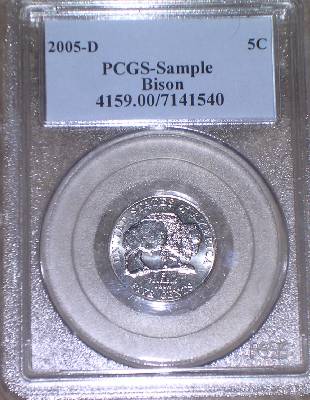
This same site has photographs of coins for grading, and I have started to use that. I found that I was probably 'undergrading' many coins: something I would grade G4 was really VG8 or higher. The 'photograde' site for Indian Head Cents is here.
The photo album for my Indian Head Cents is here.
I have also bought some folders for some other coin sets, including 2 books for Lincoln Memorial Cents. I moved the few I had from another Lincoln set book, then started going through our 'penny jar'. Perhaps because we are in Minnesota, I have filled in all the 'D' slots (Denver mint). I am missing quite a view 'plain' (Philadelphia) and 'S' (San Francisco) pennies. Note that only a few years have the S mint mark. Lincoln Memorials were minted from 1959 through 2008. (I remember when they first came out). In 2009, there was a special series for the bicentennial of Lincoln's birth, then starting in 2010, a new 'reverse' is used. More information from Wikipedia: http://en.wikipedia.org/wiki/Penny_(United_States_coin)#Lincoln_penny. Most Lincoln memorial pennies are worth 1 cent, unless they are in 'mint state' (MS-65) or a proof (PF-70). I won't be searching EBay for missing dates, but will check the pennies I get in change.
I have a fair number of Lincoln 'Wheat' cents and will probably start categorizing and photographing those as my next 'project'.
.
Thursday, July 29, 2010
'New' songs I'm working on.
The last mention of 'new songs' on my somewhat deprecated Geezer Guitar Blog is from April, 2009. Of the songs mentioned in that post, Across the Plains of Illinois has fully entered the Bob&Lynn repertoire and we've performed Over the Mountain at farmer's markets -- All I Got's Gone is getting ready to be tried at farmer's markets: I have the words down pretty well.
Of course for me, 'New' means new-to-me old songs. Here's some I've been working with source information and 'progress':
At the 2009 Bluff Country Gathering, I attended a workshop on Maybelle Carter Guitar presented by Darren Moore and Jeremy Stevens with the New North Carolina Ramblers. Darren plays an arch-top guitar tuned 3 half-steps lower than standard. I started experimenting with an Epiphone jumbo guitar that I had bought as a 'farmer's market' guitar. I ended up putting baritone guitar strings on it and tuning it 4 half-steps lower than standard (C,F,B-flat,E-flat,G,C). I use a thumbpick and a John Pearse hi-rider fingerpick to achieve the 'Carter Srcatch'. The fingerpick is 'flattend' and extends out enough so that you can brush both ways. A you tube video that gives a fairly good idea of what Maybelle is doing is here (go to about 1:23 to get to her playing).
The following songs have been added to our repertoire using the 'Low-tuned' Guitar. Lynn is playing regular 6-string guitar, sometimes in a fairly high capo position. We play these fairly close to the original Carter Family version:
Can The Circle Be Unbroken: I have sung this as "Will the Circle be Unbroken', but never really learned the words. Our source is the 1935 recording and we follow the rhythm closely (it's crooked). This actually determined the tuning of the Epiphone, since Sara sings it in A-flat while Maybelle is playing in C position on her guitar tuned 4 half-steps down. This key fits my voice: A is a bit high. We have run into trouble with 'strong' sing-along singers since they will do the four-square 'Will the ...' version.
Keep On The Sunny Side: Lynn has sung this before, so she takes the lead. We started with the Capo on the 2nd fret (key of B-flat), however, in a duet workshop with Laurie Lewis, they had her move it up to C, and that is where we sing it now. Of course, this puts the capo on the 4th fret which brings it back to standard tuning. However, the sound of the Epiphone comes very close to Maybelle's sound even capoed up, so we continue to do it using the Epiphone. So far, I am just harmonizing on the chorus, mostly as a low tenor. They drop a beat going into the chorus and we've kept that.
It Takes A Worried Man: This is a song I've avoided for 40 years because of the ubiquity of the Kingston Trio version. I am pretty certain that I performed it with the folk trio I was in in high school. I sing it the way the Carter Family sings it in the key of A-flat - no capo, C-position. The low melody is fun to play. Again, I've run into problems if strong-singers sing along, since the rhythm is different from the more recent version.
Some other Carter Family songs with Low Guitar we are considering or working on:
Bury Me Beneath the Willow: A few local musicians do this -- Lynn sings this and I do a quasi AP harmony on the chorus. I put the capo on the 2nd fret so on the low tuned Epiphone we end up in B-Flat. This should be in the Bob&Lynn repertoire at some point.
Sad and Lonesome Day: The North Carolina Ramblers did this at Lanesboro and I've heard a couple of other performances sense. The Carter Family does this in D and although I tried lower keys, I ended up here myself. (My tenor matches Sara Carter's at later points in her career). This probably will be in the Bob&Lynn repertoire at some point, although we only have so much room for these types of sad, "my mother is dead", type of songs.
Wabash Cannonball: I sang Doc Watson's version in the '60's and '70's, then found that the Delmore Brother's version has some Midwestern references. I have combined some lyrics from several versions and have lately been trying it out in A-flat using the low-tuned Epiphone and a Maybelle styled lead. The jury is still out as to whether this will move forward or not.
Of course, I've also been working on songs that don't involve the low-tuned Epiphone:
New River Train: I learned a "jam' version in the late 60's or early 70's, probably from Doc Watson, but a similar version is on Blake and Rice's first album. A few years ago I bought a collection of Ernest Stoneman 78 recordings and was taken by the word and 'tempo' of his version. We do it now with mandolin and guitar in G. We have performed it, although we still consider it 'new'.
All the Good Times are Past and Gone: I became aware of this song from a version that Norman and Nancy Blake do on one of their recent albums. I then heard a 78 version, done by Fred and Gertrude Gossett, which I am using as our basic source. We've performed this at least once and we've been doing it at farmer's markets this summer. Perhaps "Fred&Gertrude" were the "Bob&Lynn" of their time, this appears to be on the only 78 they recorded.
I Loved You Better Than You Knew: This is Carter Family song. Although Norman and Nancy Blake do this , I came across the Carter Family 78 while searching for songs to do using the low-tuned Epiphone, but I wound up playing this with a flat-pick using my regular guitar. We performed this in E-flat at the Lynnhurst Home Companion last February, but thought that it lacked energy when we were preparing it for a gig in the Spring. I have started singing in F (a full step higher), and it may rejoin the repertoire.
Cindy: I have a younger sister named Cindy and my Dad used to sing the 'common' version of this with the chorus:
Get along home, Cindy Cindy,
Get along home, Cindy Cindy,
Get along home, Cindy Cindy,
I'll marry you some day.
Thus, I have shied away from doing this; however, the version by Riley Puckett & ClaytonMcMichen caught my ear. The rhythm is crooked and the chorus is a bit different:
Get along home,
Get along home
Get along home (Cindy)
Cindy, fare thee well.
Since Puckett and McMichen repeated a lot of the verses and had extended fiddle breaks, I added a couple of verses from Cindy in the Meadows by Samantha Bumgarner and Eva Davis. I started learning this on Mando, thinking that Lynn might get a kick out of doing Riley Puckett like guitar runs; however, she started playing it on fiddle. We have played it at a couple of farmer's markets using fiddle and mandolin and it seems to be working. Although we have 'arranged' a few tunes for fiddle&mando, this will be our first 'vocal'.
Of course for me, 'New' means new-to-me old songs. Here's some I've been working with source information and 'progress':
At the 2009 Bluff Country Gathering, I attended a workshop on Maybelle Carter Guitar presented by Darren Moore and Jeremy Stevens with the New North Carolina Ramblers. Darren plays an arch-top guitar tuned 3 half-steps lower than standard. I started experimenting with an Epiphone jumbo guitar that I had bought as a 'farmer's market' guitar. I ended up putting baritone guitar strings on it and tuning it 4 half-steps lower than standard (C,F,B-flat,E-flat,G,C). I use a thumbpick and a John Pearse hi-rider fingerpick to achieve the 'Carter Srcatch'. The fingerpick is 'flattend' and extends out enough so that you can brush both ways. A you tube video that gives a fairly good idea of what Maybelle is doing is here (go to about 1:23 to get to her playing).
The following songs have been added to our repertoire using the 'Low-tuned' Guitar. Lynn is playing regular 6-string guitar, sometimes in a fairly high capo position. We play these fairly close to the original Carter Family version:
Can The Circle Be Unbroken: I have sung this as "Will the Circle be Unbroken', but never really learned the words. Our source is the 1935 recording and we follow the rhythm closely (it's crooked). This actually determined the tuning of the Epiphone, since Sara sings it in A-flat while Maybelle is playing in C position on her guitar tuned 4 half-steps down. This key fits my voice: A is a bit high. We have run into trouble with 'strong' sing-along singers since they will do the four-square 'Will the ...' version.
Keep On The Sunny Side: Lynn has sung this before, so she takes the lead. We started with the Capo on the 2nd fret (key of B-flat), however, in a duet workshop with Laurie Lewis, they had her move it up to C, and that is where we sing it now. Of course, this puts the capo on the 4th fret which brings it back to standard tuning. However, the sound of the Epiphone comes very close to Maybelle's sound even capoed up, so we continue to do it using the Epiphone. So far, I am just harmonizing on the chorus, mostly as a low tenor. They drop a beat going into the chorus and we've kept that.
It Takes A Worried Man: This is a song I've avoided for 40 years because of the ubiquity of the Kingston Trio version. I am pretty certain that I performed it with the folk trio I was in in high school. I sing it the way the Carter Family sings it in the key of A-flat - no capo, C-position. The low melody is fun to play. Again, I've run into problems if strong-singers sing along, since the rhythm is different from the more recent version.
Some other Carter Family songs with Low Guitar we are considering or working on:
Bury Me Beneath the Willow: A few local musicians do this -- Lynn sings this and I do a quasi AP harmony on the chorus. I put the capo on the 2nd fret so on the low tuned Epiphone we end up in B-Flat. This should be in the Bob&Lynn repertoire at some point.
Sad and Lonesome Day: The North Carolina Ramblers did this at Lanesboro and I've heard a couple of other performances sense. The Carter Family does this in D and although I tried lower keys, I ended up here myself. (My tenor matches Sara Carter's at later points in her career). This probably will be in the Bob&Lynn repertoire at some point, although we only have so much room for these types of sad, "my mother is dead", type of songs.
Wabash Cannonball: I sang Doc Watson's version in the '60's and '70's, then found that the Delmore Brother's version has some Midwestern references. I have combined some lyrics from several versions and have lately been trying it out in A-flat using the low-tuned Epiphone and a Maybelle styled lead. The jury is still out as to whether this will move forward or not.
Of course, I've also been working on songs that don't involve the low-tuned Epiphone:
New River Train: I learned a "jam' version in the late 60's or early 70's, probably from Doc Watson, but a similar version is on Blake and Rice's first album. A few years ago I bought a collection of Ernest Stoneman 78 recordings and was taken by the word and 'tempo' of his version. We do it now with mandolin and guitar in G. We have performed it, although we still consider it 'new'.
All the Good Times are Past and Gone: I became aware of this song from a version that Norman and Nancy Blake do on one of their recent albums. I then heard a 78 version, done by Fred and Gertrude Gossett, which I am using as our basic source. We've performed this at least once and we've been doing it at farmer's markets this summer. Perhaps "Fred&Gertrude" were the "Bob&Lynn" of their time, this appears to be on the only 78 they recorded.
I Loved You Better Than You Knew: This is Carter Family song. Although Norman and Nancy Blake do this , I came across the Carter Family 78 while searching for songs to do using the low-tuned Epiphone, but I wound up playing this with a flat-pick using my regular guitar. We performed this in E-flat at the Lynnhurst Home Companion last February, but thought that it lacked energy when we were preparing it for a gig in the Spring. I have started singing in F (a full step higher), and it may rejoin the repertoire.
Cindy: I have a younger sister named Cindy and my Dad used to sing the 'common' version of this with the chorus:
Get along home, Cindy Cindy,
Get along home, Cindy Cindy,
Get along home, Cindy Cindy,
I'll marry you some day.
Thus, I have shied away from doing this; however, the version by Riley Puckett & ClaytonMcMichen caught my ear. The rhythm is crooked and the chorus is a bit different:
Get along home,
Get along home
Get along home (Cindy)
Cindy, fare thee well.
Since Puckett and McMichen repeated a lot of the verses and had extended fiddle breaks, I added a couple of verses from Cindy in the Meadows by Samantha Bumgarner and Eva Davis. I started learning this on Mando, thinking that Lynn might get a kick out of doing Riley Puckett like guitar runs; however, she started playing it on fiddle. We have played it at a couple of farmer's markets using fiddle and mandolin and it seems to be working. Although we have 'arranged' a few tunes for fiddle&mando, this will be our first 'vocal'.
Cindy is an iconic folk song and there is an extensive discussion on The Mudcat Cafe - the discussion include a link from a Led Zepplin(!) blog , which is surprisingly informative.
Red Rocking Chair: this is another traditional song that I have wanted to learn for a while. I really liked Big Medicine treatment of this at The Bluff Country Gathering this year and I was able to re-listen to it on their CD Pine to Pine. This is another song with many variations and verse possibilities. The earliest 'source' that I have is form Dock Boggs who recorded "Sugar Baby" in the 1920s - this was included in Harry Smith's Anthology of American Folk Music. Lynn and I are still working on the arrangement, but it looks like she'll play fiddle while I am on guitar. I have added one verse to Big Medicine's version and we are listening to a few other versions, including "Sugar Babe" by Uncle Earl for some ideas.Monday, July 12, 2010
Biking, Infrastructure and a City that works...
We are heading out to Montana this week for an extended family trip that includes a niece's wedding near Helena on Saturday. I am taking two weeks off, but we are not hitting the road until Wednesday. Today, before starting some of the trip prep, I biked for the second day in a row around 'the lakes': Cedar, Isles, Calhoun and Harriet. Since it's a Monday, I was thinking that it was sort of practice for retirement, although it is probably the summer of 2014 before I can do it for real. In addition, being a one-day-at-a-time kind of person, I don't like to dwell on the 'Once I retire' plans. Enjoy the moment, etc... Still the weather was cool and it was a great ride.
I recently finished Bicycle Diaries by David Byrne which at least partly is about Urban Biking. As I biked I did some reflecting on some of his thoughts about livable cities and also noticed things that a livable city, like Minneapolis, has to provide to stay 'livable'.
First off is infrastructure: the city has been doing some sort of waterworks project on S. Cedar Lake Road and a couple of days ago placed dozens of longish yellow pipes in front of our neighbor's house (on the street). This morning they started putting them together. Here's a picture from our yard.
 When I bike, I usually go down the front stairway, then take Oliver down to the Bryn Mawr Meadows and finally cross the tracks that run under 394 to get to the Cedar Lake Trail.
The pipes and workers forced me out the back alley, so I took Penn and crossed the bridge over 394 and took one of the official bike/walkways to cross the tracks.
I might try this again since it didn't seem to take that much longer AND I don't have to dismount from the bike and schlep it over the tracks.
Although I used to climb the hill up Kenwood Parkway to get to Lake of the Isles, I now avoid an arduous climb in the lowest gear and just take Cedar Lake & Kennilworth trails to 21st Street and turn left. This takes me past downtown Kenwood to the Lake of the Isles bike path. From there I am on trails that go around Lake Calhoun and Lake Harriet. I had done the same route yesterday (Sunday): there was a lot less bike and foot traffic today.
However, there was quite a bit of activity on Lake Calhoun. At the main sailboat dock, there were a dozen or two adults huddled around a sailboat with an instructor showing them 'the ropes'. Then down the path a bit were a bunch of kids (10-12 year olds) assembling sun fish sailboats (with some instructors as well). About 30-40 minutes later, on my way back after going around the rest of Calhoun and Lake Harriet, I noticed from the far side of the lake a clump of small sailboats out on Calhoun, plus a cluster of the little sunfish hugging the shore. I am pretty sure that these classes are put on by the Lake Calhoun Sailing School (a non-profit). Of course the fact that Theodore Wirth and others had the foresight to keep these lakes 'public' makes this kind of thing possible.
Sunday, I noticed a lot of sail boats on Lake Harriet, but there were not too many (if any) on a Monday. However, there was plenty of foot traffic. Baby strollers, conversationalists and folks walking their dogs. And at least one professional dog walker -- at least I hope that the guy with 10 dogs on leash was a professional. Not very many bikes at all today, so my leisurely pace was stress free. (Usually, the fast Lycra crowd avoids the lake, but you do get a few).
I think these were among my first full "Tour de Lakes" trips this season. For long trips, especially on weekends, I often take the Cedar Lake Trail out to Hopkins and back. So I think it's been about two years since I've biked the full lake route. Last summer I didn't bike much because of hip replacement surgery (& aching hip before that). I remember a stretch at the south end of Lake Calhoun that used to go over old sidewalk. This has been replaced with new asphalt - infrastructure work and resultant livability continues!
Yesterday, my trip had a nominal errand value since I stopped at Calhoun village and bought a book at Barnes and Noble and a loaf of bread at the Rustica Bakery ... and I had a cup of Bull Run Coffee - made by the cup. Today I just stopped for coffee and read a couple chapters of "The Unbearable Lightness of Scones", the latest in the Scotland 44 Series by Alexander McCall Smith.
From Calhoun Village I took the Kenilworth bike way pretty much straight home. On the way I passed workers on three riding mowers mowing along the parkway, part of the Park Boards 'Parkway Maintenance'. Finally, on the last stretch of Kenilworth, a young couple going the other way passed me riding a couple of Neon Green Nice Ride Bikes. Although I haven't had a chance to use the service, it was David Byrne's appearance in Minneapolis for the official launch that led me to get my own copy of Bicycle Diaries.
I recently finished Bicycle Diaries by David Byrne which at least partly is about Urban Biking. As I biked I did some reflecting on some of his thoughts about livable cities and also noticed things that a livable city, like Minneapolis, has to provide to stay 'livable'.
First off is infrastructure: the city has been doing some sort of waterworks project on S. Cedar Lake Road and a couple of days ago placed dozens of longish yellow pipes in front of our neighbor's house (on the street). This morning they started putting them together. Here's a picture from our yard.

The pipes and workers forced me out the back alley, so I took Penn and crossed the bridge over 394 and took one of the official bike/walkways to cross the tracks.
I might try this again since it didn't seem to take that much longer AND I don't have to dismount from the bike and schlep it over the tracks.
Although I used to climb the hill up Kenwood Parkway to get to Lake of the Isles, I now avoid an arduous climb in the lowest gear and just take Cedar Lake & Kennilworth trails to 21st Street and turn left. This takes me past downtown Kenwood to the Lake of the Isles bike path. From there I am on trails that go around Lake Calhoun and Lake Harriet. I had done the same route yesterday (Sunday): there was a lot less bike and foot traffic today.
However, there was quite a bit of activity on Lake Calhoun. At the main sailboat dock, there were a dozen or two adults huddled around a sailboat with an instructor showing them 'the ropes'. Then down the path a bit were a bunch of kids (10-12 year olds) assembling sun fish sailboats (with some instructors as well). About 30-40 minutes later, on my way back after going around the rest of Calhoun and Lake Harriet, I noticed from the far side of the lake a clump of small sailboats out on Calhoun, plus a cluster of the little sunfish hugging the shore. I am pretty sure that these classes are put on by the Lake Calhoun Sailing School (a non-profit). Of course the fact that Theodore Wirth and others had the foresight to keep these lakes 'public' makes this kind of thing possible.
Sunday, I noticed a lot of sail boats on Lake Harriet, but there were not too many (if any) on a Monday. However, there was plenty of foot traffic. Baby strollers, conversationalists and folks walking their dogs. And at least one professional dog walker -- at least I hope that the guy with 10 dogs on leash was a professional. Not very many bikes at all today, so my leisurely pace was stress free. (Usually, the fast Lycra crowd avoids the lake, but you do get a few).
I think these were among my first full "Tour de Lakes" trips this season. For long trips, especially on weekends, I often take the Cedar Lake Trail out to Hopkins and back. So I think it's been about two years since I've biked the full lake route. Last summer I didn't bike much because of hip replacement surgery (& aching hip before that). I remember a stretch at the south end of Lake Calhoun that used to go over old sidewalk. This has been replaced with new asphalt - infrastructure work and resultant livability continues!
Yesterday, my trip had a nominal errand value since I stopped at Calhoun village and bought a book at Barnes and Noble and a loaf of bread at the Rustica Bakery ... and I had a cup of Bull Run Coffee - made by the cup. Today I just stopped for coffee and read a couple chapters of "The Unbearable Lightness of Scones", the latest in the Scotland 44 Series by Alexander McCall Smith.
From Calhoun Village I took the Kenilworth bike way pretty much straight home. On the way I passed workers on three riding mowers mowing along the parkway, part of the Park Boards 'Parkway Maintenance'. Finally, on the last stretch of Kenilworth, a young couple going the other way passed me riding a couple of Neon Green Nice Ride Bikes. Although I haven't had a chance to use the service, it was David Byrne's appearance in Minneapolis for the official launch that led me to get my own copy of Bicycle Diaries.
Monday, July 5, 2010
41st Anniversary Lunch
Since I had the day off (July 5th, 2010 was the 'observed' July 4th holiday), Lynn suggested we go to Mill City Cafe for 'Brunch'. However, as we checked into whether it was 'open' or not, we discovered that it is always closed Monday. I started looking for alternatives using the City Pages 'critic pick' list. A lot of these, however, were also closed Monday or only open for dinner (after 5pm).
We ended going to Kings on 46th and Grand in South Minneapolis. This was on the 'critics pick' and I had just read an article in Minn Post about it. When we got there a little after 1:00, it 'looked' closed: the door opened, but the only one in there was a guy washing windows. But just as we were about to leave, the waitress on duty came to the door (from the outside) and invited us in. (She had just moved her car for some reason). Although there was a strong smell of ammonia from the window washing solution bucket, we took a table and proceeded to have a really good lunch. (Thankfully, the window washer was done before any of our food came). As our lunch proceeded, a few more folk came in as well.
We shared the Ratatouille for an appetizer -- Lynn had the Braised Beef Short Ribs, I had the Pulled Pork Sandwich. The flavors were exquisite (especially the 'balsamic reduction' for the Ratatouille) and portions were right-sized. Although it won the City Pages 'Best Wine Bar' this year, we just had coffee and water.
We shared the Ratatouille for an appetizer -- Lynn had the Braised Beef Short Ribs, I had the Pulled Pork Sandwich. The flavors were exquisite (especially the 'balsamic reduction' for the Ratatouille) and portions were right-sized. Although it won the City Pages 'Best Wine Bar' this year, we just had coffee and water.
Lynn was checking out the Sat/Sun Brunch Menu (our church is just down the street at 45th and Colfax): the waitress came by checking to see if she was looking at dessert ;-). We ended up splitting the apple crisp with Sebastian Joe's Ice Cream.
This was a fine way to highlight a very low key anniversary (which is often the case: we almost always go to the annual Danebod 4th of July party and need a 'rest day'.)
Who knows, this may be the start of a mid-day anniversary meal tradition - just might suit us better than going out for 'dinner' and staying up too late ;-)
Thursday, July 1, 2010
Bicycle Diaries
I finished Bicycle Diaries by David Byrne at Rustica. This was one of my travel books for the trip to San Francisco so I was happy to read at least a portion of the epilogue at a place I actually biked to. I had given this book to my brother-in-law Otto, an avid bicyclist last fall. David Byrne was in Minneapolis at an event celebrating the inauguration of a bike sharing system - "Nice Ride". I needed some books for traveling so I ordered it and it came in time for the trip to San Francisco. The book is a distillation of his journal; I had followed this for a while and have bookmarked it again. For me, the journal sometimes gets confusing: many of the postings are on contemporary art and I really don't have enough knowledge of the subject to put his musings in context. However the book benefits from some good editing and reads something like an old fashioned travel memoir.
Bryne takes a folding bike on most of his travels and likes to get at the essence of a city by 'biking around'. He is NOT a sports bicyclist and usually bikes around in street clothes (he owns no spandex!). Although I appreciate the exercise I get biking (and the improved blood sugar readings I get), I have been trying to fit it more into my daily life. We'll see how that goes.
Byrne's point is more at making cities livable then just 'biking' and he cites some city planners and others who have been part of the movement to get us out of our cars and 'on the street'. I have done some casual reading on this and am glad to see that Minneapolis is starting to become one of the leaders. The epilogue explicitly goes into this - much of the book actually goes into projects, concerts and people that he has worked with. You don't have to be 'into biking' to enjoy this.
When I worked at the Black Forest Inn during the 70's and 80's, David Bryne was a 'regular' one summer during a stint at the Walker art center - some Google searching indicates that he was working on The Knee Plays, which was 'produced' in 1984. Although I didn't follow the Talking Heads at the time, I have since bought a few albums (Vinyl from Ebay) and reading this book has kindled an interest in his more recent projects. Although Bryne spent much of his childhood and high school years in a Baltimore suburb he was born in Scotland -- surely a good thing.
More on David Byrne: Web Site Wikipedia
Bryne takes a folding bike on most of his travels and likes to get at the essence of a city by 'biking around'. He is NOT a sports bicyclist and usually bikes around in street clothes (he owns no spandex!). Although I appreciate the exercise I get biking (and the improved blood sugar readings I get), I have been trying to fit it more into my daily life. We'll see how that goes.
Byrne's point is more at making cities livable then just 'biking' and he cites some city planners and others who have been part of the movement to get us out of our cars and 'on the street'. I have done some casual reading on this and am glad to see that Minneapolis is starting to become one of the leaders. The epilogue explicitly goes into this - much of the book actually goes into projects, concerts and people that he has worked with. You don't have to be 'into biking' to enjoy this.
When I worked at the Black Forest Inn during the 70's and 80's, David Bryne was a 'regular' one summer during a stint at the Walker art center - some Google searching indicates that he was working on The Knee Plays, which was 'produced' in 1984. Although I didn't follow the Talking Heads at the time, I have since bought a few albums (Vinyl from Ebay) and reading this book has kindled an interest in his more recent projects. Although Bryne spent much of his childhood and high school years in a Baltimore suburb he was born in Scotland -- surely a good thing.
More on David Byrne: Web Site Wikipedia
Subscribe to:
Posts (Atom)